
When Traitors Are Celebrated as Heroes - The Treasonous Roots of Teddy Roosevelt & Why McKinley was MurderedAn Account of the True ‘American System’ History and Why You are Being Lied to Today Part II
In Part I of this series, we went over the banking war that has been waging within the United States since its inception – between the American System school of protectionism vs the British Empire’s free trade and pro-Wall Street school of economics. It is this battle which was at the heart of the War of 1812 and the US Civil War and the murder of Alexander Hamilton, Abraham Lincoln, James Garfield and…William McKinley. In fact, Teddy Roosevelt’s hero and mentor, his uncle James D. Bulloch, was directly implicated in the assassination of Lincoln. As proven by Barry Sheehy in Montreal City of Secrets, John Wilkes Booth had been recruited to a Confederate secret intelligence network with deep roots in British Canada and had even spent five weeks in Montreal before killing Lincoln. Additionally, as Anton Chaitkin demonstrated in 2014, James D. Bulloch- chief of Confederate operations in England, directly signed off on a $31,507.97 wire transfer to Confederate agencies in Canada which directly funded Lincoln’s murder. Chaitkin writes:
It is here not inconsequential that Bulloch was also the maternal uncle of Teddy Roosevelt as well as his mentor and strategic advisor. In fact, Teddy helped his uncle produce his 1883 memoir, The Secret Service of the Confederate States in Europe… When Teddy Roosevelt attained power over the dead body of McKinley, just six months after he was announced as Vice President, it was Bulloch, and not Lincoln which inspired his foreign policy doctrine dubbed ‘the Roosevelt Corollary to the Monroe Doctrine,’ and formation of the Anglo-American ‘Special Relationship’. This is of course, the same Teddy Roosevelt that Trump has repeatedly celebrated as a model for a 21st century US foreign policy doctrine.
Immediately after Lincoln’s death, Wall Street and their allies began pushing for the removal of the greenbacks and a return to a gold back dollar (the gold standard which was controlled by the gold houses in London) and a lowering of tariffs. Since Trump’s election as President, there has been a great deal of discussion around the need to revive the country’s better traditions, namely, its tradition of promoting industrial growth – what had allowed America to become great in the first place, to which the American school of protectionism vs the British school of free trade was key. However, there has been a rather troubling and consistent mixture of names by members of the Trump administration, who have paraded many historical men as representatives of the school of protectionism when they clearly stood on the opposite side. In US Trade Representative Jamieson Greer’s recent Davos speech titled ‘From Hamilton to Today: Trade and U.S. Economic Strategy’, for instance, which trumpeted the legacy of Alexander Hamilton as the founder of the American System, there were some names that were included in this legacy who were in fact outright enemies of this American System, such as Teddy Roosevelt and John Maynard Keynes. Strangely the name William McKinley was nowhere to be found in Greer’s speech, who focused rather on Teddy Roosevelt as the president of protectionism in the 20th century, when in fact Teddy did much to undo McKinley’s tariff system.
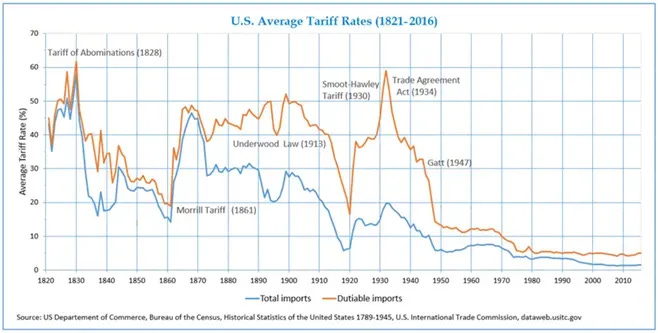
As we see with the above graph, since the presidencies of Abraham Lincoln (1861-1865) to William McKinley (1897-1901), protective tariffs were brought back up to a rate averaging at about 45%. This was a massive increase from its low at ~15% by 1861 after a slew of Anglophile, pro-free trade, pro-Wall Street presidencies, notably that of Andrew Jackson (1829-1837), Martin van Buren (1837-1841), James K. Polk (1845-1849), Franklin Pierce (1853-1857) and James Buchanan (1857-1861) where we see a drastic drop in protective tariffs from over 60% down to a low of about 15% by the end of both Jackson and Buchanan’s terms (see Part I of this series). There were some exceptions within this period, such as Zachary Taylor (1849-1850), however, he was poisoned just one year into his term. (For more on this story and why Taylor was murdered refer here.)
It was through Henry C. Carey’s organising of the Morrill Tariff that the United States was finally put back on track in its American System school of protectionism. Henry C. Carey was Lincoln’s economic advisor and son to Mathew Carey, one of the founders of the American System. Though some presidencies, such as Chester A. Arthur (1881-1885) who became president over the dead body of James Garfield, and Grover Cleveland (1885-1889, 1893-1897) worked to undo this system of protectionism, the work of men such as Lincoln, Henry Carey, Garfield, James Blaine, Wharton Barker and McKinley during this period from 1861-1901 successfully maintained the American System (see Part I). However, the death of McKinley would act in many regards as a death blow to this legacy and would see America’s entry into the 20th century as a partner to the British Empire’s economic and geopolitical vision for the world, rather than its most powerful opponent. As we see in the above graph with the beginning of Teddy Roosevelt’s presidency (1901-1909), over the dead body of McKinley, there is a drop in protective tariffs from 50% to 40%, this drop continues under Teddy’s protégé William Howard Taft (1909-1913) followed by Woodrow Wilson(1913-1921), who as we will see in this series was in fact in league with Teddy on a common vision for the Anglo-American Empire, including the formation of the Federal Reserve. Thus, from Teddy Roosevelt’s presidency to Woodrow Wilson we see a drop in protective tariffs from 50% down to about 6%, the lowest it had ever been at that point in America’s entire history! These presidencies, from Teddy Roosevelt to Woodrow Wilson were united in a common vision in service to the City of London and the British Empire as this series will showcase. This battle within the United States, between the American System vs the British System, is showcased most transparently with the Anglophile legacy of Teddy Roosevelt who would solidify America’s “Special Relationship” to Britain, empower Wall Street banks in service to the City of London, aid in the creation of the Federal Reserve, create America’s Secret Police with Charles Bonaparte (the origins of the FBI) and create the Roosevelt Corollary which would empower the United Fruit Co. where American Intelligence and the mafia worked together towards regime change in Latin America, paramilitary operations and a massive influx of drugs (these will be discussed in Part III, IV and V of this series). The traitorous roots of Teddy Roosevelt are seen most clearly with the life of his mentor and hero, Teddy’s uncle James D. Bulloch, who ran the Confederate Intelligence services out of Liverpool, England during the Civil War, was directly implicated in the assassination of Lincoln and facilitated the funding and construction of effectively the entire Confederate navy while stationed in Great Britain, including the CSS Alabama. Thus, I think it is finally time dear reader, that you hear the true story of why McKinley was shot down and how Teddy Roosevelt destroyed what would have been one of the greatest legacies of an American president…. “An American by Birth, an Englishman by Choice”
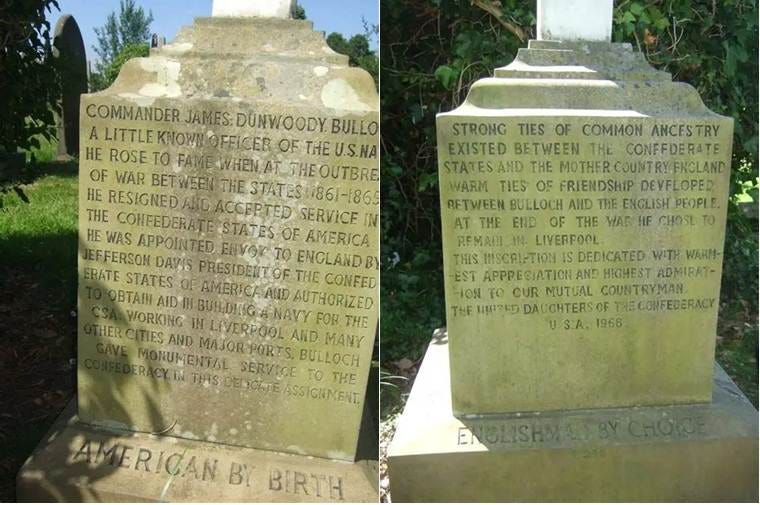
“American by Birth, Englishman by Choice“ is what is inscribed on the tombstone of James Dunwoody Bulloch who was a Confederate secret agent for Great Britain, who worked as the Confederacy’s chief foreign agent stationed in Liverpool, England during the Civil War. In fact, Bulloch’s younger half-brother Irvine (1842-1898) also served as a secret foreign agent to Great Britain. Because of this, they were not included in the general amnesty that came after the Civil War. They lived their remaining years in Liverpool where they became successful cotton importers and brokers, loyal to the British school of free trade and cheap labor to the end of their days. Born in Georgia in 1823, James D. Bulloch passed away in 1901 at the age of 77, with the last forty-or-so years of his life in service to the British Empire. Irvine would die at the age of 56. Both brothers were buried in Toxteth Park Cemetery in Liverpool, England. And both brothers would have a close relationship with their nephew Teddy Roosevelt. The Bullochs came from a family who had made their fortune in slave-based cotton exports to Britain. In 1839 their family moved into the cotton plantation mansion, Bulloch Hall with its ten-acre plot. This is where Teddy’s mother also lived, half-sister to James, and where she married Teddy’s father Theodore Roosevelt Sr. James’ father (and Teddy’s grandfather) Major James Stephens Bulloch (1793-1849) became a partner with Roswell King in a new cotton mill incorporated as the Roswell Manufacturing Company in what would become Roswell, Georgia – named after Roswell King. King had made a name for himself managing Major Pierce Butler’s island plantations in Georgia. Butler’s rice and cotton plantations covered hundreds of acres on both the islands Butler and St. Simons. King was in charge of managing over 500 slaves, though it would appear Butler and King did not see eye to eye on what should be the treatment of these slaves.[1] The New Georgia Encyclopedia writes:
King in turn owned his own plantation in Darien, Georgia and became the director of the Bank of Darien. His son Roswell Jr. continued to manage Butler’s plantations. According to the journal entries of the wife of Pierce Butler, Fanny Kemble (a noted British actress), both King Sr. and King Jr. were known for their extreme cruelty with the slaves and that they had fathered several children from slave women who in turn were kept as slaves. Kemble records how many slaves, especially the women, would come to her and plead for better treatment. This put a toll on their marriage, and Butler threatened to remove access to her children if she published her observations of the barbaric cruelty that was occurring on his plantations under the management of Roswell King Sr. and Jr. Kemble did not publish her account until 1863, long after their divorce in 1849, after her daughters reached adulthood – the book was titled Journal of a Residence on a Georgian Plantation.[2]
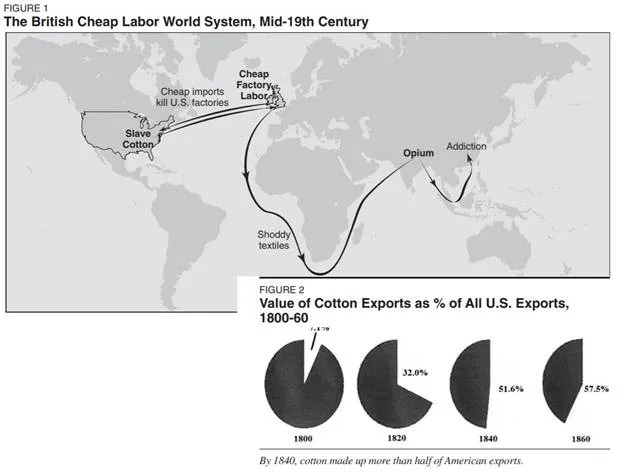
It was this Roswell King Sr. who was good friends with Major Bulloch, who brought Bulloch in as partner to his large cotton enterprise - the father of James D. Bulloch and grandfather to Teddy Roosevelt. This is relevant since James and Irvine Bulloch would in turn fund the Confederate Navy and later make their own personal fortunes in Liverpool, England as cotton importers and brokers from these Southern plantations. Upholding the British System of free trade with the United States kept under-developed and treated as one large plantation in service to the industries of Great Britain, most notably, its cotton textiles.
However, before James and Irvine made their fortune in Southern cotton, they worked as Confederate secret agents for the British Empire. It would appear C.S.A. Attorney General Judah P. Benjamin was the one who would launch James’ career into Britain’s secret service in 1861, where he was sent to Montgomery, Alabama for his assignment. James would quickly become known as “the most dangerous man” in Europe, according to Union State Department officials.[3] Less than two months after the attack on Fort Sumter in April 1861 (what officially launched the Civil War), Bulloch arrived at Liverpool, England and established a base of operations there. Because the South’s entire economic base was pretty much dependent on exporting their slave-based cotton to British textiles, the Union blockade which blocked this transaction worked to deprive the South of pretty much its only source of revenue…which should speak volumes of whether they were in fact fighting for “liberty” during the Civil War or rather to remain as England’s loyal dog. James Bulloch established a relationship with the shipping firm Fraser, Trenholm, & Company, based in Liverpool, to buy and sell Confederate cotton – the company became, in effect, the Confederacy’s international bankers. This firm acted as the European banker, or more accurately, British banker of the Confederacy and often extended it credit, such that it sometimes was referred to as “the Confederate Embassy in England.”[4] [5] So much for England’s “neutrality.”
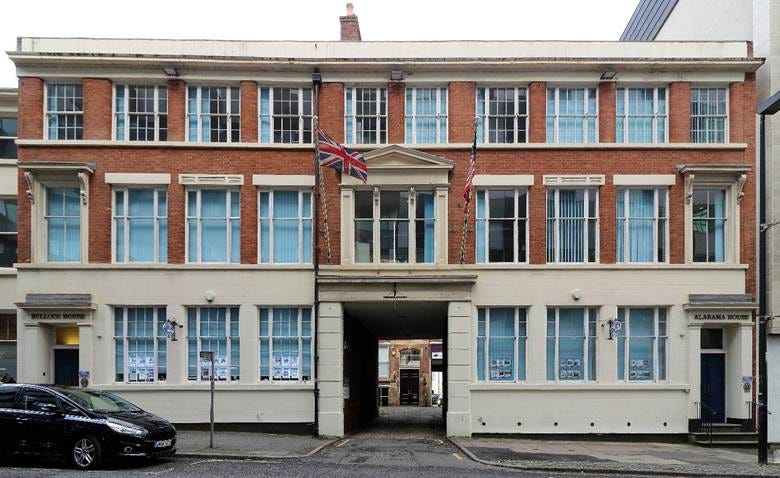
In the above image we see the former offices of Fraser, Trenholm & Co., we can see overtop of the door to the right the “Alabama House” and to the left the “Bulloch House,” showcasing the direct line from the state of Alabama and Bulloch’s management of Fraser, Trenholm & Co. in Liverpool, in funding the Confederate cause during the Civil War. James Bulloch arranged for the construction and secret purchase of the infamous commerce raider, the CSS Alabama in England - which attacked the Union’s naval ships and merchant fleets causing considerable disorder and devastation on American merchant shipping throughout the globe. Included in its attacks were American grain ships bound for Europe. Irvine Bulloch served in the Confederate States Navy on the CSS Alabama and later the CSS Shenandoah. It is said that it was Irvine who fired the last shots from the CSS Alabama before it went down in the harbor of Cherbourg, France. James was involved in constructing and acquiring a number of other warships and blockade runners for the Confederacy, including the Sea King, which was renamed the CSS Shenandoah. Thus, James Bulloch led the procurement of ships for the Confederate States Navy that were being constructed in England (since the South had no manufacturing base to do this for themselves even with British funding from their slave-based cotton). The South was entirely dependent on Britain for most of its war needs since they had no industrial base and no economy outside of their plantation exports, which apparently, the South was willing to die for to keep it that way. In order for Britain to continue its dubious claim of “neutrality” the contract arranged through the cotton broker Fraser, Trenholm & Co. managed by James, could under the prevailing British neutrality law, build a ship designed as an armed vessel, provided that it was not actually armed until after it was in international waters. In light of this loophole, Alabama was built with reinforced decks for cannon emplacements, ammunition magazines below water level, etc., but was not fitted with armaments or any “warlike equipment” originally. It’s like selling a gun as if it isn’t a weapon since it was sold without bullets. In 1871, Britain lost to America in the world’s first international court case dubbed ‘The Alabama Claims’ where England was found guilty of breaking neutrality during the U.S. Civil War by manufacturing the Confederate warships through James Bulloch. This resulted in a $15 million settlement brokered by soon-to-be US president Ulysses S. Grant and Hamilton Fish. Let us not forget that James D. Bulloch was also directly implicated in the murder of Abraham Lincoln, as Anton Chaitkin demonstrated in 2014, who directly signed off on a $31,507.97 wire transfer to Confederate agencies in Canada which directly funded Lincoln’s murder. Chaitkin writes:
Bulloch was directly implicated in the Lincoln assassination, through his pivotal role as liaison between the British intelligence services and the Confederacy. And his choice of inscription on his tombstone “An American by Birth, An Englishman by Choice” should be very telling of how he saw the cause of the “Confederate States” in the U.S. Civil War… Teddy Roosevelt would grow up with his mother telling him heroic tales of his two uncles. He would later write that his mother used “to talk to me as a little shaver about ships, ships, ships and the fighting of ships, until they sank into the depths of my soul.” Teddy would meet his uncles in person several times in his life and corresponded frequently with James by letter. James would be the inspiration for Teddy’s book on naval strategy, The Naval War of 1812, and as already mentioned Teddy would help his mentor James produce his 1883 memoir, The Secret Service of the Confederate States in Europe. Teddy Roosevelt had this to say of his uncles in 1905 while visiting Roswell, Georgia, where the fortune of the Bulloch family was made in their partnership with Roswell King in slave-based cotton:
It is clear here that Teddy’s source of pride lies in his Southern roots and is giving the rather confused message that everyone should feel “equal pride” in fighting for either side during the Civil War, as if it made no difference. Of course, this speech of Teddy works more as an apology for the traitorous role of the South in the war, that they should feel pride in this shameful history where they fought to remain subservient to England with the breaking apart of the United States - and lost. The fact that Teddy made this speech in Roswell, Georgia of all places, should speak volumes – Roswell was full of symbolic sentimentality for Teddy as the proud foundation of his ancestral legacy. Why McKinley was MurderedWilliam McKinley had this to say of the American System vs the British System at the University of Michigan on May 17th, 1892, where students had gathered from over 30 universities to hear the future president speak:[6]
These words by the Republican William McKinley should offer us some clarity in the confused state we find ourselves in today, where ironically, many Republicans today share the same idols of the Anglophile Democrats back in the 19th century. Again, recall it was the Democrats who were pro-Confederate and whose political machine in New York, Tammany Hall, was run by the Anglophile traitor Aaron Burr who was guilty of a treasonous secessionist plot in service to the British Empire in 1807. All notable gang activity in New York answered to Tammany Hall. And it was Aaron Burr, who worked for the British Secret Service, who had murdered Alexander Hamilton in 1804 (see Part I of this series).
In this speech to the University of Michigan, McKinley could not make it any clearer the difference between the American System school of protectionism vs the British school of free trade, where the revenue tariff (promoted by the Democrats) effectively worked with the same destructive effect as that of free trade policy. [Note: see my paper for more on what is a revenue tariff vs a protective tariff and how the Trump Administration today is in fact using a revenue tariff, the very opposite of what McKinley was working towards.]
McKinley makes it crystal clear what he thinks on these matters, free trade and revenue tariffs work to tear the nation’s industries down, whereas protective tariffs work to build the nation’s industries up. McKinley also makes it clear that with the American System labor is not cheap but well paid and products are of a higher quality due to a skilled workforce, whereas with the British System of free trade, both the product and labor become cheap. It was this battle between these two economic systems, the American vs the British, which was at the core of the U.S. Civil War, where the South fought in defense of British free trade. And McKinley was very much aware of this, being the last of the Civil War veterans to be elected as President. This was at the heart of McKinley’s legacy and what he fought for his entire political life as Congressman, to Governor of Ohio to the President of the United States from 1877 until he was shot down in 1901. In 1882, then Congressman of Ohio, McKinley had delivered a powerful rebuke on free trade on the floor of the House of Representatives, noting that there was no American support for free trade, he asked, rhetorically, who did favor free trade?
In 1901, in Buffalo, New York, McKinley was fatally shot by the anarchist Leon Czolgosz, a disciple of Emma Goldman who was connected to the Henry Street Settlement House, a hotbed of anarchist activity. Goldman was temporarily arrested on charges of complicity in the murder of McKinley but was later released. However, there is much, much more to this story. Anton Chaitkin writes in London’s Murder of McKinley:
Teddy Roosevelt would assume the presidency of the United States, after only six months as Vice President to William McKinley. His presidency would undo much of McKinley’s protectionism and work to prop up Wall Street banks, laying the groundwork for what would become the Federal Reserve - he would also see to America’s entry into the 20th century as a junior partner to the British Empire’s economic and geopolitical vision for the world, rather than its most powerful opponent. [In the next instalments to this series we will discuss Teddy’s Roosevelt’s role in the creation of the Federal Reserve, his trust-busting mythos, his creation of America’s Secret Police, his role in facilitating the United Fruit Co. through his Roosevelt Corollary and how he was the anti-thesis to McKinley’s and James Blaine’s work to help industrialise and remove colonialism throughout Latin America.] Cynthia Chung is the President of the Rising Tide Foundation and author of the books “The Shaping of a World Religion” & “The Empire on Which the Black Sun Never Set,” consider supporting her work by making a donation and subscribing to her substack page Through A Glass Darkly.
Footnotes:[1] https://www.georgiaencyclopedia.org/articles/history-archaeology/roswell-king-1765-1844/ [2] Kemble, Frances Anne (1984). Journal of a Residence on a Georgian Plantation in 1838–1839. Edited and introduction by John A. Scott. Athens, Georgia: University of Georgia Press. [3] Wilson, Walter E. and Gary L. McKay. James D. Bulloch; Secret Agent and Mastermind of the Confederate Navy. (Jefferson, NC: McFarland, 2012). [4] Douglas, Stewart (2005). “Charles Kuhn Prioleau, The Man who Bankrolled the Confederacy”. American Civil War Society (UK). [5] Edwards, William B. (1962). Civil War Guns. The Stackpole Company, pg. 86 [6] https://record.umich.edu/articles/it-happened-at-michigan-college-republicans-and-their-u-m-roots/ [7] Sam Labrier’s RTF lecture “Trump, Tariffs and Treason: A Return to the True Economic Heritage of the United States”
|













No comments:
Post a Comment