
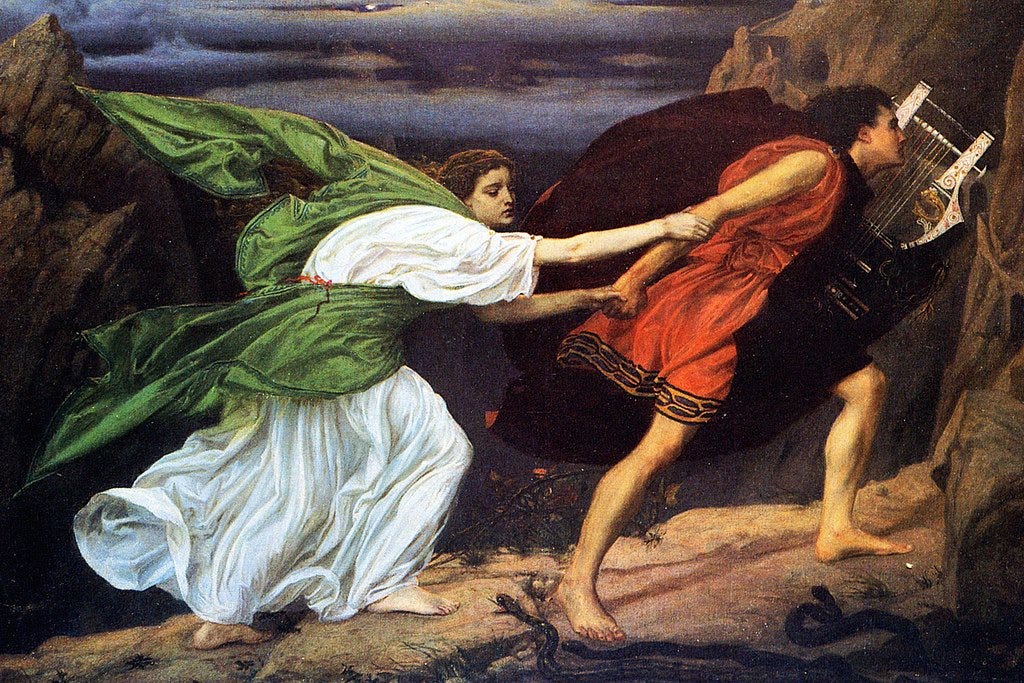
“Is this meant to be funny?” I caught thinking this to myself consistently as I cleaned houses with Stephen Fry’s Greek Mythos Audiobooks entertaining my ears. Understanding eloped me however until the second interview MayCee and I did with Megha Lillywhite where she exclaimed, “Romeo and Juliet wasn't a Romance, it was a Tragedy.” It exemplifies the triumph that Hollywood Culture has had over my mind in eroding the tenet that Greece is revered for its Tragedies. Amidst my listening to Mythos, Heroes, The Iliad, and Odyssey, my incredulity as to the fatal blunders demonstrated repeatedly by each character made me scoff, cackle, gasp; my mom consistently sought me from within the client’s house to check if something had happened upon hearing my outbursts! My account to the clan began, “they have to be fables using extensive irony, anything else seems ridiculous to me - like how can people be so heedless?” I was stupendously stupefied by the tale of Orpheus. My enamourment with music aggrandized my inclination toward his archetype…so I fell extra flat upon hearing his inexplicable demise.
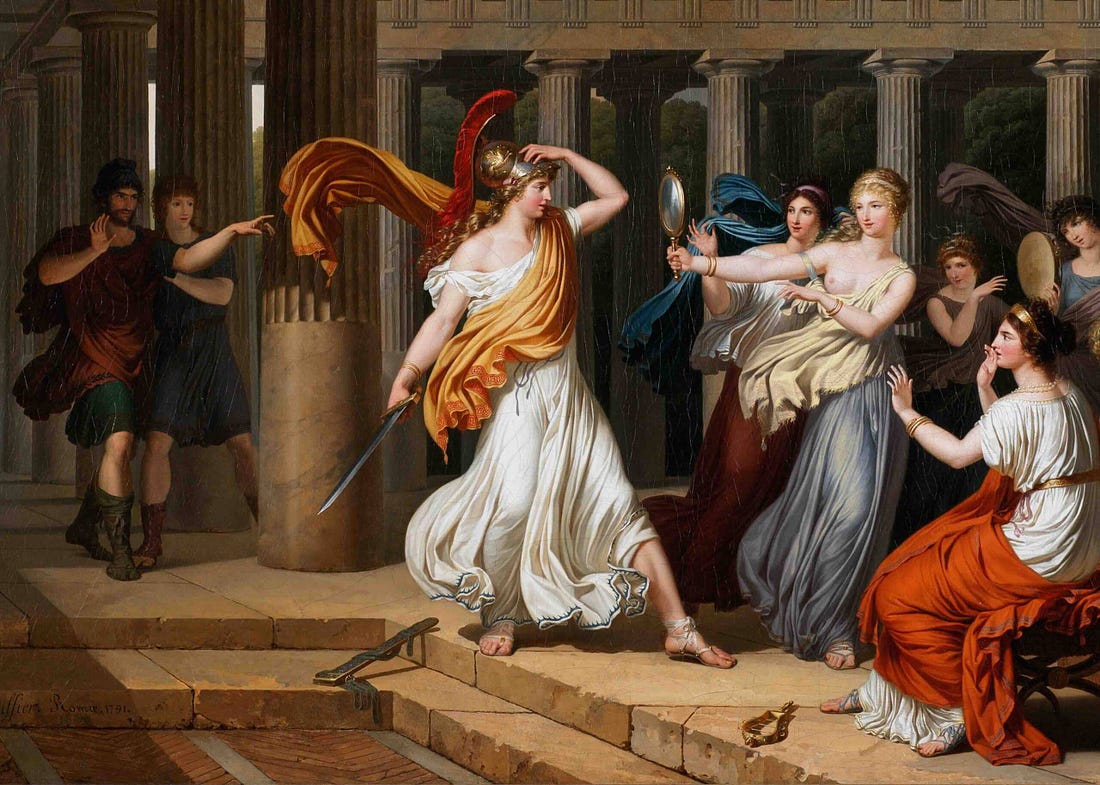
Sigh…still gets me. Howbeit, that same incredulity I felt listening to those Greek Myths, I felt upon reading Romeo and Juliet. The tenacity of the characters to make literally fatal blunders: in school I remember being one of the only girls who couldn't reconcile it a “romance” because I was appalled by the absurdity. Well bless this world for Megha Lillywhite who reminded me of its purpose. Shakespeare was evidently inspired by the Greek Tragedies, and only in that context did Shakespeare and the Myths finally reconcile within me. Listening to the Myths inspired me to further listen to the Socratic Dialogues (beyond the homework I had been given by Matthew Ehret…👀). I recently finished the Lesser Hippias Dialogue where Socrates inquires with Hippias “Who is the better man: Achilles or Odysseus?”
The parameter they set upon to decide this is: whether or not it is better to do ill voluntarily, or involuntarily. Take pause and ponder it, come back to this exposition later if you need. Despite Plato and Socrates being revered by people I myself venerate, I know any sagacity I've been delt is in my discernment and discretion. Hence I consciously do not agree with everything in the dialogues so to extract the real beauty of their lessons, which is to continue the conversations. Hippias advocated Achilles for the better man because he did not consciously do ill. Socrates contrary believed that any action done involuntarily, not of the will, is inferior by nature for it was not intended; done so without the mind, thus power. I could pedantically refer to examples Socrates and Hippias use for my refutation but even upon first instinct I felt the false dichotomy present itself. Call me a Nuance Nazi but context matters. Involuntary action may be considered inferior for its omission of the “conscious will”, but that would discount the fact that our brains fulfill actions on a quotidian millisecond basis without our recognition. Should my brain suddenly stop communicating with my body to SUB-consciously facilitate my breathing, I doubt anyone reading this would dub that as superior. Though I did not "will" it, it was still done of my mind. Thus the tenet presents that: just because it was not conscious, does not mean it wasn’t me. I am my subconscious mind just as much as my conscious, does that make me a slave to myself? Perhaps yes to one hemisphere but definitely not to the other (comment if you can identify which hemisphere inclines to which and why!) If a man intentionally lies, is he automatically better if he can justify his reasoning? If a man does something accidental (therefore involuntarily), are his initial intentions derelict? By my account, not all justifications are created equal and not all accidents are morally compromising: as in 'the path to hell is paved with good intentions' idiom. Doing ill voluntarily or involuntarily does not properly address moral context; for a man to be 'better' than another, his intentions weigh in. A doctor that intended to save a life but accidentally fails administration, is not the same as our contemporary Canadian MAID (Medical Assistance In Dying) program where doctors intentionally end lives. Now I will not argue that all uses of MAID are immoral, for I myself have never been in a pain that I wasn't able to withstand. It very well may be the better thing to facilitate or allow someone with an immutable condition to end their life; especially if the individual has lost the will to fight, because how can we expect ourselves to save someone who doesn't want to be saved? This further illustrates my principal tenet: context matters when regarding morals, and therefore intentions; it is not a dichotomy. Sometimes doing ill voluntarily is justifiable as in defending your family, other times doing ill voluntarily is simple malignity. Sometimes doing ill involuntarily is an accident resulting from worldly ignorance (inexperience), other times it is involuntary ill because of self-ignorance: you yourself were oblivious to your real intentions. Either have real world consequences that need to be navigated as any sea condition does. "You have Less control than you think but More than you'll ever know." There is more of the world than us: by default then we are disproportionately not in control. We make the decisions we can then based on what little we are given. Does that make us feeble? I would say not. Lack of control does not equate to impotence. This is where wisdom be our guide so to work in harmony with the river rather than swim against it, thus gain further distance. To wind up this exposition I share a brilliant lecture from the Rising Tide Foundation on Homer's Odyssey. The reason it transcends generations is the same reason Socrates/Plato does, and is the same reason I wrote out all these thoughts: Odysseus ended his journey by sharing it. Without the sharing of experiences, the human condition is not complete. We have never known a time of absolute isolation and therefore to cast wide the stories of our lives is to embody the nature of existing. Conversing is certainly one immediate way of accomplishing this, but writing breaks boundaries; even language barriers are eroded given time as was done with the Socratic Dialogues. Socrates for all his dialogues didn't write them down, albeit his wisdoms reached local ears, the lesson he encouraged of continuing the conversations in pursuit of truth...credit goes to Plato for vitalizing that to perpetuity; perhaps Plato embodied that wisdom more than Socrates himself because of it? Being in a family of seven, I know the importance of communication. Howbeit, upon reflection of my Poetry Anthology soon to come out, it dawned on me the unabashed reality that writing reveals about one's own mind: to unveil habits, patterns, and all idiosyncratic secrets of the self that might elude us. Writing is a concrete mirror of your mentation, unsubtly exposing of where you are; or aren't.
This is why I write, because my self-improvement journey began with honesty and my pertinacity beckons me to perpetuate the example for others to regard. So, without further ado... Till the next exposition! ~Madison
|








No comments:
Post a Comment