This Sunday April 28, at 2pm eastern time, the Rising Tide Foundation weekly lecture will feature Africa Agenda editor-in-chief PD Lawton who will present on ‘High Speed Railways and Hieroglyphics’ (yes they are connected). Anticipate a review of some incredibly important deep history and a look to some extremely positive pathways to a new renaissance for Africa during this upcoming presentation. Click on the link below to access it live:... Subscribe to Rising Tide Foundation to read the rest.Become a paying subscriber of Rising Tide Foundation to get access to this post and other subscriber-only content. A subscription gets you:
|
Saturday, April 27, 2024
RTF lecture invitation: High Speed Railways and Hieroglyphics (yes they are connected)








Thursday, April 25, 2024
Why We Need the Tragic: Schiller, Cassandra and the Rebirth of Tragedy
By David Gosselin [originally published on Antigone]“Trust me, the fountain of youth, it is no fable. It is running —Friedrich Schiller, The Fountain of Second Youth There are prophecies in every age. The doom of empires and the fall of kings remain perennial themes because of their timeless reality. Poets have often been the bearers of these prophecies; in Western civilized culture, this gift of poetical prophecy is chiefly the preserve of the tragic, epic, and biblical traditions. The verses of David’s psalms, the dactyls of Homer and the tercets of Dante immortalized poets’ thoughts and ensured their transmission through enduring poetical forms. As the poet Percy Bysshe Shelley wrote in his Defence of Poetry (1821):
In musical forms, the bards of old ensured their verses would phrase, not only man’s highest thoughts, but the common wisdom of all humankind. With respect to their poetical forms, Shelley wrote:
When we consider the role played by poets in the rebirth of civilizations across the ages, particularly Classical Greece, little by way of civilizational rebirth has been left untouched by what Shelley referred to as poetry’s “secret alchemy”.
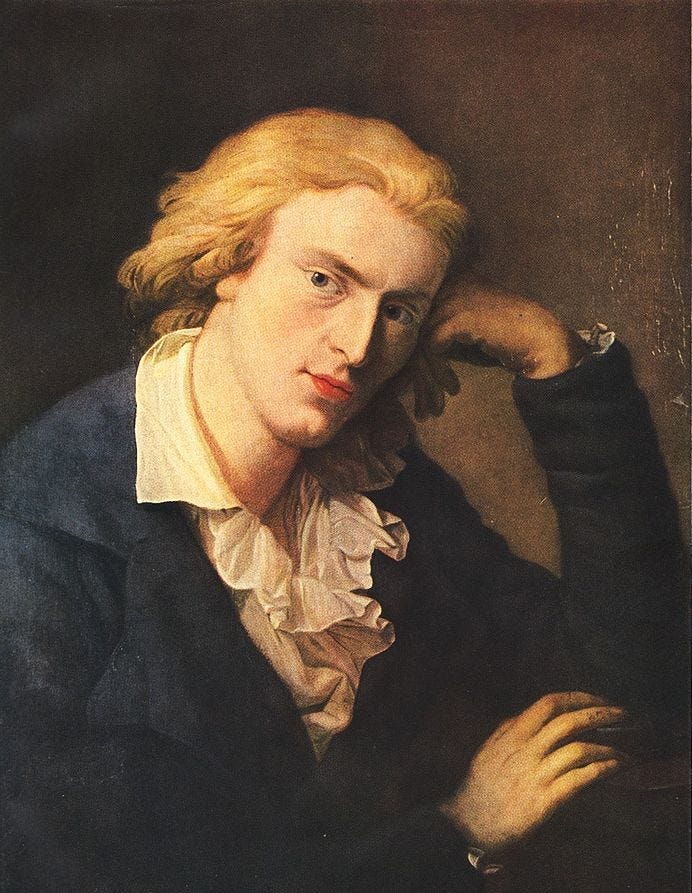
Schiller: A Window into Hellenism As in any classical age, rebirth begins by intimately acquainting ourselves with the best of our tradition, and situating it within our own unique times. The 18th-century German poet and playwright Friedrich Schiller thoroughly imbibed the wisdom and beauty of the Classical Greeks was, and succeeded in reviving it within his own age, known as the Weimar Classical Renaissance. Heralded as “the Shakespeare of Germany”, Schiller (1759–1805) presided over Germany’s illustrious classical revolution, alongside Goethe. Many of their poems served as inspirations for composers including Beethoven, Schubert, Schumann and Brahms. No less than Beethoven’s supreme Ninth Symphony was composed as a setting of Schiller’s “An die Freude” (Ode to Joy).
Of Schiller’s epic ballad the “Cranes of Ibykus”, the preeminent Classical philologist Wilhelm von Humboldt wrote in 1797:
Through a reading of Schiller’s criticism and original works, modern readers discover an intimate view of Greek greatness through the eyes of one of the most successful vanguards of Hellenism in modern history. Passionate about the achievements of Ancient Greece, Schiller observed that the Classical Greeks pioneered the tragic form as we know it, tracing its origins to the Greek chorus. He maintained that the chorus was the binding force of tragic drama, observing that even with its ostensible departure from the stage, the chorus remained the animating spirit of Greek theatre.
In On the Employment of Chorus in Tragedy, Schiller writes:
He goes on to discuss the relevance of the chorus principle for modern tragedy and poetry:
Finally he concludes:
With such insights, it’s no surprise that Schiller successfully captured the essence of Greek tragedy within his own era. Rather than merely trying to imitate the outward formal elements of the Classics, Schiller rediscovered their spirit and gave the tradition new life, which is as integral to preserving a tradition as observing its sacred rites or reading its foundational works.
Schiller’s most extensive discussions on the state of the poetical arts and their role in society can be found in Letters on the Aesthetic Education of Man, where he writes of the true artist’s role in a society that wishes to enjoy the pleasures of fine art, and reap its transformative effects on the tastes and morals of a people: The Artist, it is true, is the son of his age; but pity for him if he is its pupil, or even its favorite! Let some beneficent Divinity snatch him when a suckling from the breast of his mother, and nurse him with the milk of a better time that he may ripen to his full stature beneath a distant Grecian sky. And having grown to manhood, let him return, a foreign shape, into his century; not, however, to delight it by his presence; but terrible, like the son of Agamemnon, to purify it. The matter of his works he will take from the present; but their Form he will derive from a nobler time, nay from beyond all time, from the absolute unchanging unity of his nature. Here from the pure aether of his spiritual essence, flows down the Fountain of Beauty, uncontaminated by the pollutions of ages and generations, which roll to and fro in their turbid vortex far beneath it.[3] With ballads like “The Ring of Polycrates,” “Cassandra” and “The Cranes of Ibykus”, Schiller managed to infuse Greek pathos and vitality with his own moral and philosophical clarity.
On the Tragic In Why We Take Pleasure in Tragic Subjects, Schiller examines why tragedy has remained an important and enduring form in Western civilization. He begins by outlining the essential nature of fine art, of which tragedy remains one of the most exalted and moving expressions: Thus, the fine arts have their purpose in common with nature, or actually with her Author. They playfully grant what [pleasure] their more serious sister allows us to obtain only with labor; they make a gift of what is usually the bitterly won prize of much effort. We purchase enjoyments of the mind with straining diligence, the sanction of reason with painful sacrifice, the pleasure of the senses with austere abstinence, or atone for the excesses of these with a train of suffering; only art affords us pleasures which need not first be earned, which demand no sacrifice, and need not be purchased with repentance.[4] The performance of a great tragedy affords audiences the opportunity to see the tragic unfold on the stage of their imagination, rather than in real life. For this reason truly tragic art may be said to offer the proverbial “gift of prophecy”.
The Case of Cassandra Take, for instance, the myth of Cassandra, which endures as one of the most emblematic symbols of the poetical-prophetic tradition. To this day, the story continues to inspire new odes and paeans to the proverbial “Cassandras” of the world. Cassandra foresees the future, but is cursed with the fate that no-one believes her. What are we to make of this? Why should any of us take pleasure in seeing someone tell the truth and never be believed? Schiller describes tragedy as the art which grants audiences the most pleasure and which, for this reason, has the greatest moral effect on our tastes and sensibilities. Why? The answer lies in “the sublime”. Schiller articulates the nature of the elevated pleasure derived from the sublime as something distinct from the beautiful and commonplace delights drawn from any other kind of amusement.
In On the Sublime, he writes:
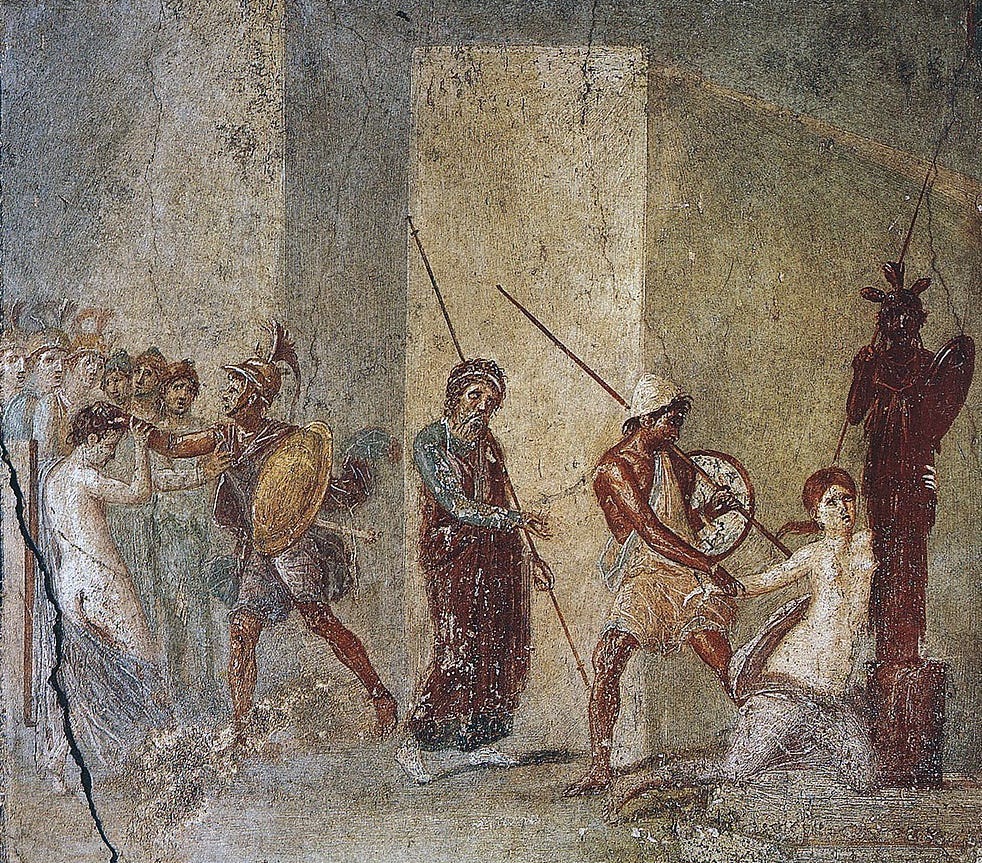
Cassandra shuns the advances of the enthralled god Apollo to preserve her chastity and integrity. The god punishes her by turning her gift of prophecy into a curse: she will see the future, but no-one will believe the truth she foresees.
The anguish we feel when presented with the plight of tragic figures causes us to discover in ourselves a faculty which we otherwise find nowhere else. We find ourselves conscious of an independent principle which transcends the natural condition to which all other beings are relegated. Schiller observes that only when we can freely choose the anguish of the sublime over the pleasures of illusions are we truly free. Schiller concludes On the Sublime thus:
The great irony of tragic art is that it is by virtue of the pleasure derived from the tragic that one is moved to the highest delight – that of seeking Justice and the Good. Through the tragic, we take joy in perfection because the discovery of its absence highlights its ultimate primacy over all other spheres of human activity. This revelation, while “not properly pleasure”, Schiller observes, “is widely preferred to every pleasure by fine souls.”
Listen to Schiller’s “Cassandra.” Cassandra by Friedrich Schiller 1Letter of 7 December, 1797, translation taken from Rosa Tennenbaum, “1797, The ‘Year of the Ballad’ — In the Poets’ Workshop,” Fidelio 7.2 (Spring 1998) 61–77, at 76. 2Friedrich Schiller, The Bride of Messina, Prologue (1803), translation here and in the next two excerpts taken from G.W. Gregory (trans.), Friedrich Schiller: Poet of Freedom Vol. 4 (Schiller Institute, Washington, DC, USA, 2003). 3Translation by Thomas Carlyle, from his Life of Friedrich Schiller (London, 1825). 4Translation taken from G.W. Gregory (trans.), Friedrich Schiller: Poet of Freedom Vol. 4 (Schiller Institute, Washington, DC, USA, 2003). 5Translation here and in the following excerpt taken from W.F. Wertz, Jr (trans.), Friedrich Schiller: Poet of Freedom Vol. 3 (Schiller Institute, Washington, DC, USA, 1990). Cassandra I. II. III. IV. V. VI. VII. VIII. IX. X. XI. XII. XIII. XIV. XV. XVI. Translation © David B. Gosselin David Gosselin is a poet, translator, and researcher in Montreal, Canada. He is Editor-in-Chief of The Chained Muse. His epic poem in iambic blank verse, Athena, is featured in the latest issue of New Lyre Magazine. His poems, recordings and historical deep-dives can be found on Substack at Age of Muses. You're currently a free subscriber to Rising Tide Foundation. For the full experience, upgrade your subscription.
|





Subscribe to:
Posts (Atom)
The World Needs a Renaissance, Not an Enlightenment
Both the Renaissance and the Enlightenment are gravely misunderstood in the popular imagination. ͏ ͏ ͏ ͏ ͏ ͏ ...

-
Boundaries are the backbone of respect. ...
-
Yernasia Quorelios posted: " In the dream, I was queued with my friends waiting to be seated at a formal dinner that wa...
-
Everyone loves a good story. The problem is that storytelling, like any branch of art, can sometimes be a double edged sword that can make u...


