
The following short article will also be found in an upcoming Rising Tide Foundation Spring Anthology ‘The Art of Liberty’ which will be released later this week. Until then I wanted to provide a teaser to everyone subscribed… enjoy. A Universal Lesson in Navigating Troubled Waters“There is nothing hidden which will not be revealed, nor has anything been kept secret but that it should come to light. If anyone has ears to hear, let him hear.” -Gospel of Mark 4: 22-23
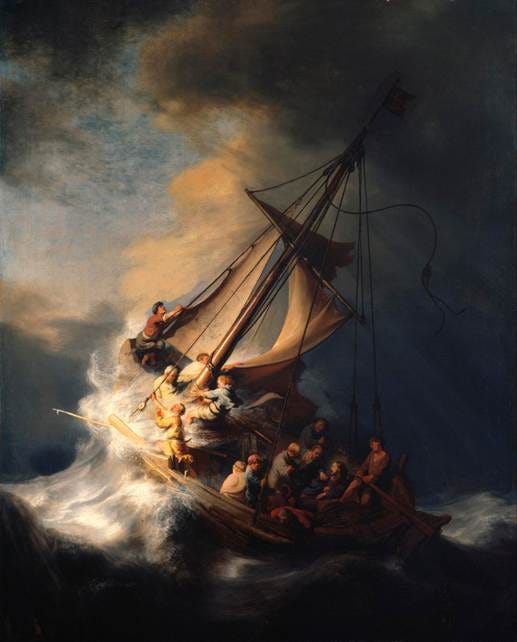
The imagery of the twelve disciples caught in a terrible storm on the Sea of Galilee with their teacher Jesus had caught the imagination of generations of Christians after the Apostle Mark recounted the story in chapter four of his Gospel some time around 71 AD amidst Nero’s persecution of the early Christians and destruction of the Temple in Jerusalem. The imagery of shaken faith of Jesus’ followers, the fear of our mortality, the loss of sense of control over our fates, and the feeling of injustice that lives may be cut short before our hopes can be fulfilled are universal motifs. With each generation, men and women are challenged to face the discrepancy between their moral ideals, their sense of values and those tumultuous waves of despair and injustice that fall upon our lives, testing our faith with each step. Thus, it is understandable that amidst the terrible violence of the Thirty Years War that tore across Europe from 1618 to 1648, and which saw millions of Christians die by the hands of fellow Christians, that faith in a loving God was being challenged like never before. In this chaotic period, a young Dutch painter by the name of Rembrandt van Rijn found within the story of the storm at the Sea of Galilee, a theme that merited artistic expression. But how to best do it? Rembrandt’s rendition stands out from all efforts to paint this scene before or since due to several unique innovations that had never been attempted before. For one thing, Rembrandt uses chiaroscuro (the science of light and darkness) to convey a visceral tension within the painting. Where light signifies hope, reason, life and action. Darkness symbolises fear, emotional turmoil, inaction. And the characters aboard Jesus’ fishing vessel are pulled in either direction. The light and shadow also showcase the ironical coexistence of the two states of mind of passengers aboard the endangered ship. Cast in shadowed lower half of the painting, several disciples are imprisoned by their fears.
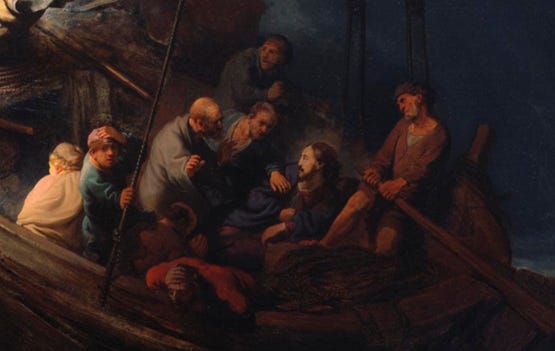
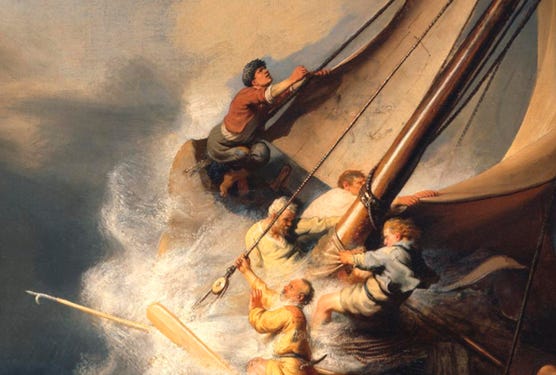
One disciple is literally portrayed vomiting over the side of the boat, while another grovels below Jesus praying, and three other disciples plead with the master to wake up and join them in their terror. Another looks on towards the audience and another sits passively looking at the front of the ship. However, moving the eye toward the light which pierces through the dark clouds and casts itself upon the front of the ship, we find five disciples hard at work taking responsibility for everyone by enforcing the rope and sails of the beleaguered vessel.
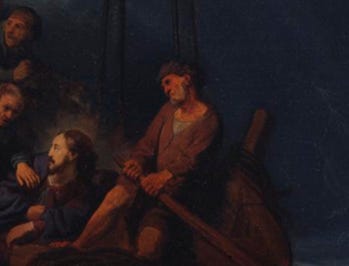
Behind Jesus only one man whose eyes are firmly set upon the horizon ahead of him has taken responsibility for the safety of the ship, by taking control of the rudder with all his might.
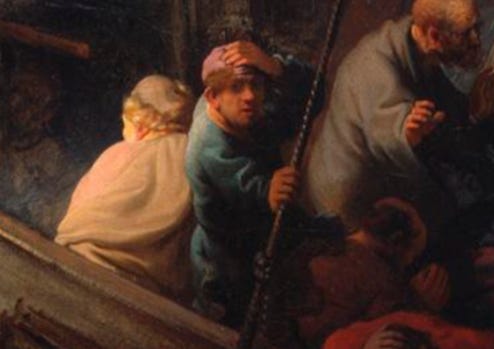
Now Rembrandt did something which some may consider heretical…he went beyond the literally words transcribed in Mark 4:35-41. Where those literal words only speak of fearful disciples amidst the storm and a stern Jesus chastising them for lacking faith in his ability to invoke the supernatural power of calming the storm devoid of any human effort, Rembrandt chose to infuse a moral lesson by featuring two opposing sets of disciples… those drowning in despair waiting for miracles to save their lives, while the other group recognizes that real miracles only come from overcoming fear, and taking action amidst a crisis. But there is yet another layer to Rembrandt’s story. How many disciples are on this fishing vessel? We all know there were twelve disciples. And nothing contained within the gospel of Mark would indicate otherwise. And yet, if we count the figures around Jesus… there are clearly thirteen people on that ship. So why the discrepancy? If we focus on the singular figure featured in the perfect center of the frame dressed in a blue shirt who is looking at every person standing in front of the painting, something stands out.
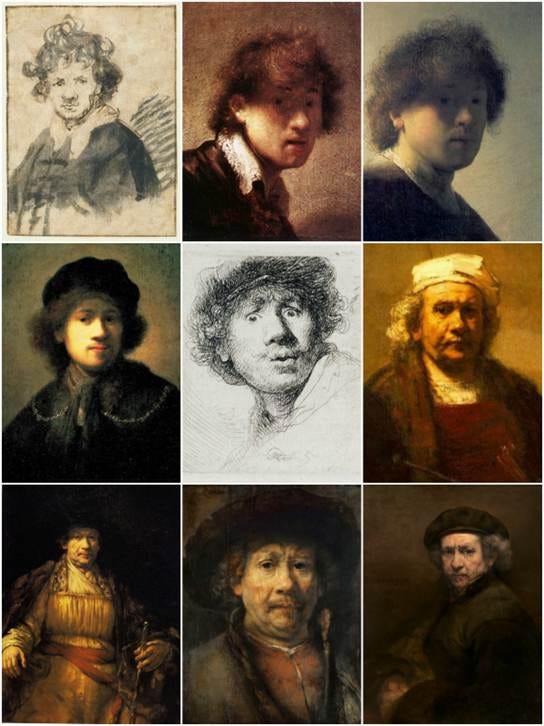
That figure holding his head with one hand, and the rope with another is in fact, the great artist himself… It is Rembrandt van Rijn! Fortunately, we can know this for certain thanks to Rembrandt’s dozens of surviving self-portraits that survived the sands of time and allow us not only a glance into his face at all stages of his adult life, but also a deeper look into his character, personality and moral disposition. Looking through his self-portraits, we find not an exercise in ego, or self-love, but rather an exercise in journaling, in humor, and an effort to speak autobiographically in a figurative language. Rembrandt always paints more than the surface appearance of the flesh but consistently attempts to ‘capture’ a glimpse of the soul.
But the question remains… why did Rembrandt include himself within this iconic story? And of all poses why feature himself looking at the audience? Could it be that Rembrandt, who is living through the chaos of the Thirty Years War, was trying to convey a message that would transcend the vast chasm of time and space itself? By conveying his own feelings of concern within the context of this historically bleak moment, while looking directly into the eyes of his viewers, Rembrandt is carrying out a trans-generational dialogue with each of us who can feel what he feels despite being separated from his life by centuries. The catharsis of that eternal sympathy makes it possible to step into the shoes of those who walked with Jesus and were captured by fear on the sea of Galilee two millennia ago. Just like it was two thousand years ago amidst the evil structures of Rome, and just like it was in the Netherlands in 1633, we again have a choice. We can choose to be caught as prisoners to our impotent fears and weep in the comfortable embrace of darkness…or we can choose to use the light of reason and construct our hope on the foundations of a firm faith grounded by reason. Rembrandt’s choice to place himself on the borderland between the two states of darkness and light was perhaps his way of conveying a sense of struggle which he felt in his own heart, and which he knew all good men and women at all times would naturally feel, pulled in opposing directions when faced with existential crisis. Were the figure of Jesus watching us today, would he wish us to do nothing in the face of evil? Would he want us to ignore the world by praying solemnly awaiting a rapture? Would he want us to passively let injustice reign and innocents suffer telling ourselves that our place is to have faith without works? Or would he want us all to stand up and make a creative intervention using the lessons that he lovingly delivered throughout the gospels as a whole and in this fourth book of Mark specifically? The lessons of the mustard seed, and the importance of seeing our words and actions (and works of art) as seeds in the minds of men that may not sprout, despite the fact that we are obliged to spread the truth far and wide and poetically. That our words may fall on many a deaf ear, or eyes that cannot see beyond the barren surface appearance of things is irrelevant to our mandate to pursue, love, defend and spread truth. And as the great master taught, despite the many seeds that will fall on barren soil, truth will find its proper fertile ground in the most surprising times and places… and by its nature, will take hold, sprout, and flourish.
The Meaning of the ParableMany would look upon this simple text without the eyes of a poet and in their own simplicity fail to see something true beyond the literal surface appearance of the words. Was Rembrandt wrong to construct his visual poem the way he did? A literalist would say ‘yes’. For the painter is showcasing ideas and actions that were not present in the literal words written by the Apostle Mark… yet was Mark or his teacher using a literal method of communication? Did Mark simply mean for the reader to accept the supernatural message of Jesus’ power to command the wind and waters devoid of any higher lessons or personal responsibility? Or was a higher truth planted as a seed to be found and nurtured by those who have the eyes to ‘see that they may truly perceive, and hear and truly understand?’ I hope this little voyage into a nested array of divine poetic minds edifies and whets your appetites for the upcoming second RTF Anthology. Get the first anthology here:
|







No comments:
Post a Comment