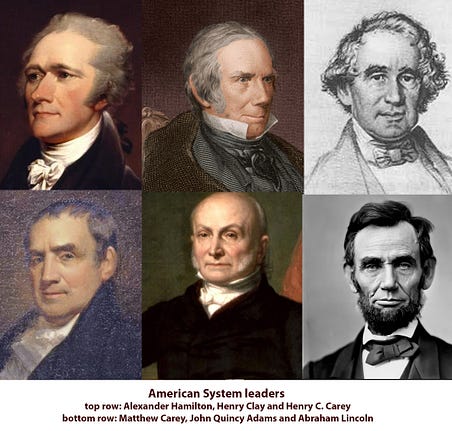
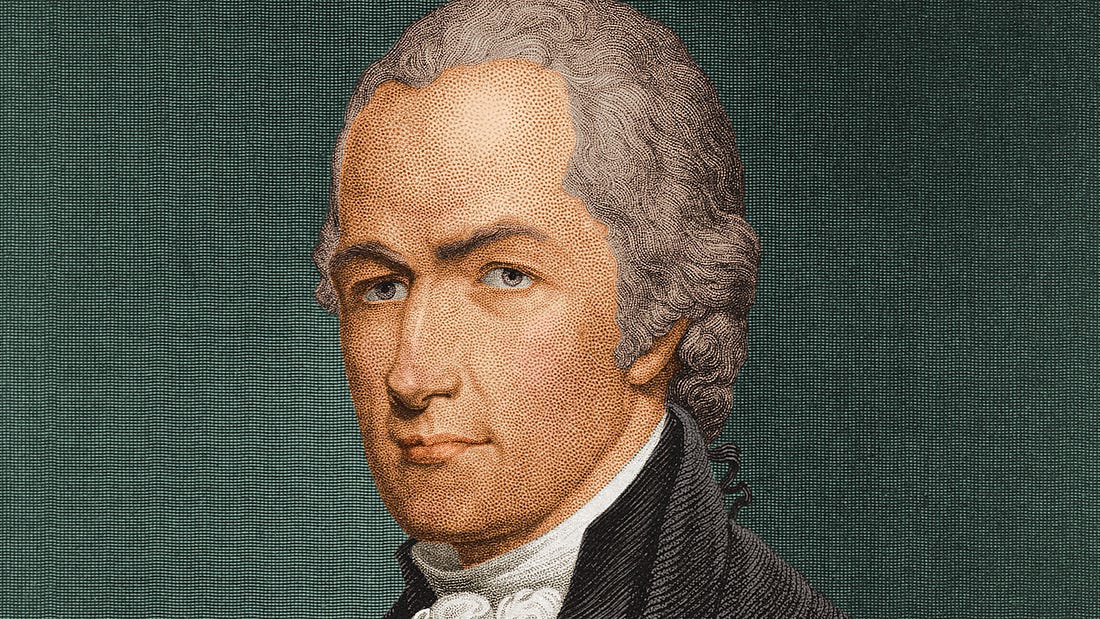
This week, many people (myself included) were shocked to hear that a speech took place at Davos, featuring a Sorbonne-trained Mormon US Trade Representative Jamieson Greer outlining the history of the American System of Political Economy from 1776 to the present. 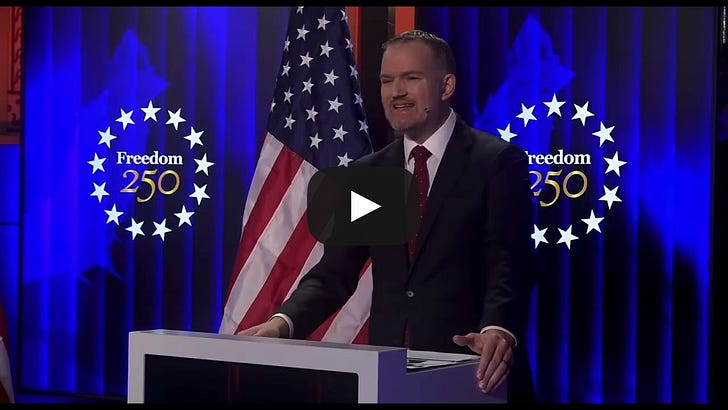 Greer’s speech was titled ‘From Hamilton to Today: Trade and U.S. Economic Strategy’ and featured a shockingly candid exposition of the American System’s origins in the wake of the US revolution, innovated by the first US Treasury Secretary Alexander Hamilton and the growth of Hamilton’s Society for the Promotion of Useful Manufactures. Greer outlined the fight to revive this system by 2nd generation Hamiltonians led by Henry Clay and John Quincy Adams, and he competently showcased how this system of protective tariffs, national planning, and international cooperation shaped the best bursts of industrial progress across both the USA and many other nations of the world.
Greer even showcased how this system led in the industrial progress enjoyed by Germany (under Friedrich List and von Bismark’s lead), in Russia, Japan (under the Meiji restoration) and even in China (led by the followers of President Sun Yat-sen). It was all sounding a bit too good to be true. How could such insightful competence be permitted into a venue as powerful as Davos by a Mormon Sorbonne trade official? Could this be evidence that patriotic forces have successfully taken control of the reigns of power in the USA after all? Sadly, towards the end of this nearly flawless presentation, Jamieson did something very strange when he extolled the brilliance of British economist John Maynard Keynes whom, Greer exclaimed, understood this American system: “John Maynard Keynes—the great British economist and the British representative to the Bretton Woods conference—had an idea for how this could be done. He argued that the international economic system needed to be organized around the principle of balance. Nations could pursue what Keynes called “national self-sufficiency” through different models of economic development, but a requirement of long-term balanced trade would protect everyone against so-called “beggar-thy-neighbor” tactics.” While no one would argue that John Maynard Keynes (1883-1946) profoundly influenced much of the international economic order during the Cold War, it would be a dangerous lie to think that he was anything other than an enemy of the American system in all of its forms. It can be proven that Keynes was no friend of liberty, or the American ideals of 1776, but was merely a servant of empire devoted to infiltrating, co-opting and then transforming the American System system into a tool of Empire, eugenics, and Hegemony. Before allowing ourselves to celebrate the victory of the American System over the City of London prematurely, I hope to demonstrate why I fear that a dangerous Trojan Horse been introduced which risks undermining all of the nice words and aspirations for the restoration of the USA to its healthier traditions. So, let’s explore that. Why FDR was NOT a KeynesianContradicting the popular mythos that FDR was a Keynesian, FDR’s assistant Francis Perkins recorded the 1934 interaction between the two men when Roosevelt told her: “I saw your friend Keynes. He left a whole rigmarole of figures. He must be a mathematician rather than a political economist.”[1] In response Keynes, who was then trying to coopt the intellectual narrative of the New Deal stated he had “supposed the President was more literate, economically speaking.”
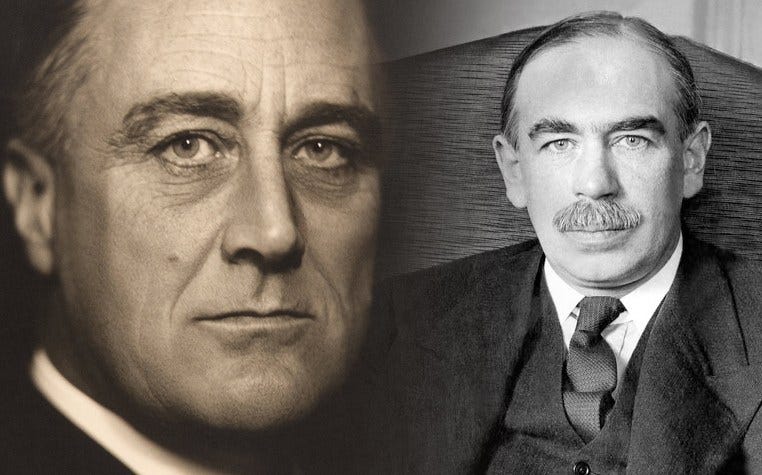
This was not mere rhetoric, as FDR’s ideas of economics were shaped entirely from the genuine school of Alexander Hamilton which he studied and promoted in his 1924 essay on the first US Treasury Secretary writing: “Washington, the first President under the Constitution, made Hamilton Secretary of the Treasury- the greatest of the Cabinet offices. As he [Hamilton] had stabilized the problems of State, so now he ordered the finances of the country and it was his impetus that removed for all time the risk of disintegration of the States. “None appreciated this solidarity more than Aaron Burr, who, defeated for the Presidency in his race against Jefferson [in 1800], largely through the efforts of Hamilton, saw in this greater financial security the banishment of his dream of establishing a Northern Confederacy”.
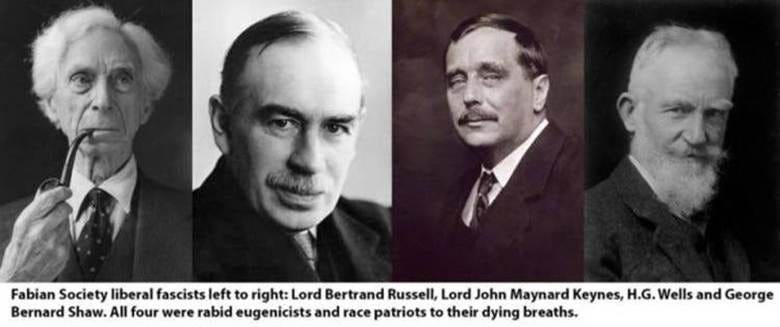
As Nancy Spannaus (author of Hamilton vs Wall Street) wrote in Countering the Myths of Alexander Hamilton: “The economic policies and style of governance which FDR needed in order to get out of the Depression required adopting Hamiltonian principles. These included re-establishing sovereign control of the U.S. currency, banking regulation (against speculation), government credit for building infrastructure and raising productivity (through the Reconstruction Finance Corporation), and support for advancing the general welfare in myriad ways. FDR pursued all these objectives, asserting he was fulfilling the mandate of the Constitution—the very Constitution which Hamilton played a major role in bringing into being, and gave his life to defend.” For anyone seeking to understand Franklin Roosevelt’s battles with the City of London and Wall Street fascists, I invite you to read my Hyperinflation Fascism and War: How the New World Order Can be Defeated Once More: John Maynard Keynes on the other hand, was a lifelong devoted loyalist to the British Empire, a promoter of radical eugenics, rampant pedophile [1.5] and even though he was no friend of nationalistic fascism of the Hitlerian variety, he had no problem with an ‘enlightened internationalist’ fascism under the influence of the Bank of England. Keynes’ Eugenics Profile: Servant of EmpireHis early 1911 book on Indian Currency and Finance (conducted during his five-year foray in the Empire’s Indian Office) ignored all actual political reasons for the famines plaguing India and argued coldly for a greater integration of the Indian banking system into the City of London controls which would somehow solve India’s problems. The provable reality was that Indian famines were coordinated tools of population control by the Malthusian elite of the British establishment who considered “war, famine and disease” as the gifts nature gave the strong to manage the weak.[2] While his later 1919 Consequences of the Peace appeared to be a reasonably sympathetic warning that the draconian Versailles reparations would do incredible damage and lead to a new world war, in reality, Keynes was displaying a cold sleight of hand. Serving as British Treasury representative to the Versailles Conference, Keynes never opposed fascism: he merely argued that a more liberal pathway to global fascism could be established under the direction of the Bank of England. His opposition, though, to the more violent approach preferred by conservative imperialists among the British Intelligentsia, was one of form more than substance. Keynes and his fellow Fabians H.G. Wells, Bertrand Russell and G.B Shaw preferred the “slow and steady” “long game”, reminiscent of the Roman general Quintus Fabius Maximus who famously fought his enemies by slow attrition rather than in full-scale confrontation[3]. Due to the public’s general ignorance of this strategy, we celebrate these Fabian Society luminaries for their pacifism, though in reality they were just as racist, fascist and eugenics-loving as their more short-sighted, hard-stomached counterparts sir Oswald Mosley, Lord Alfred Milner and even Winston Churchill.
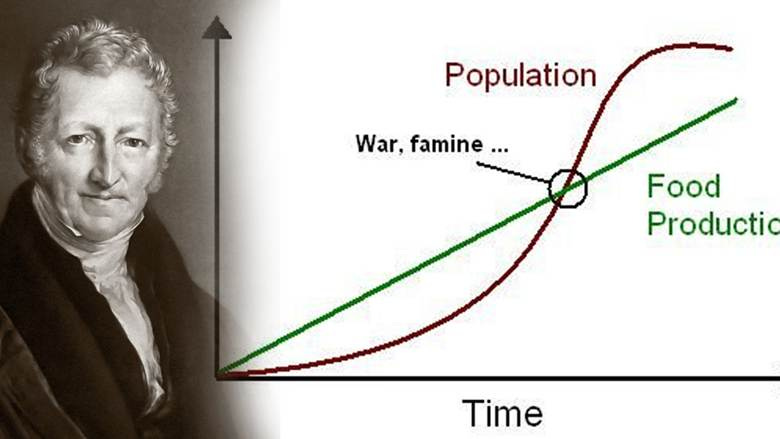
Where the real solution to the hyperinflationary money printing and economic industrial shutdown of Germany during the post WWI years was to be found in the German-Russian Rapallo Agreement (destroyed with the assassination of American System Foreign Minister Walter Rathenau[4]), Keynes and his ilk merely called for economic integration of the German banking and military system under Bank of England/League of Nations control. Keynes: Disciple of Thomas MalthusDefining his misanthropic belief in overpopulation, British East India Company economist Thomas Malthus (1766-1834) asserted a new “fundamental law” in his famous 1799 Essay on Population: “The power of population is so superior to the power in the earth to produce subsistence for man, that premature death must in some shape or other visit the human race.”
How could this crisis be avoided? Malthus answers it like only a devout imperialist could: “We should facilitate, instead of foolishly and vainly endeavoring to impede, the operations of nature in producing this mortality; and if we dread the too frequent visitation of the horrid form of famine, we should sedulously encourage the other forms of destruction, which we compel nature to use. In our towns we should make the streets narrower, crowd more people into the houses, and court the return of the plague.” Although some apologists considered Keynes an anti-Malthusian- due to his theory that overpopulation might be overcome by encouraging spending rather than savings, which would, in turn, somehow create markets and thence new factories and more growth, the reality was the opposite. Keynes not only spoke gushingly of Malthus throughout his life as one of the greatest minds of all time, but even plagiarized many of Malthus’ own theories[5], for instance that of “demand deficiency causing unemployment and recession” outlined in his 1930 Treatise on Money. In his 1933 Essay on Malthus, Keynes wrote: “Let us think of Malthus today as the first of the Cambridge economists—as, above all, a great pioneer of the application of a frame of formal thinking to the complex confusion of the world of daily events. Malthus approached the central problems of economic theory by the best of all routes.”[6] In his May 2, 1914 lecture Population[7], Keynes argued that government should “mould law and custom deliberately to bring about that density of population which there ought to be” and that “there would be more happiness in the world if the population of it were to be diminished.” Saying that “India, Egypt and China are gravely overpopulated”, Keynes advocated using violence to defend the “superior white races” in this struggle of survival with the pacifist saying: “Almost any measures seem to me to be justified in order to protect our standard of life from injury at the hands of more prolific races. Some definite parceling out of the world may well become necessary; and I suppose that this may not improbably provoke racial wars. At any rate such wars will be about a substantial issue.” As Acting chair of the Neo-Malthusian League, Keynes stated in 1927: “We of this society are neo-Malthusians… I believe that for the future the problem of population will emerge in the much greater problem of Hereditary and Eugenics. Quality must become the preoccupation.” By 1946, Keynes, still a member of the British Eugenics Society (after serving as the agency’s Vice-President from 1936-1944) wrote in The Eugenics Review: “Galton’s eccentric, sceptical, observing, flashing, cavalry-leader type of mind led him eventually to become the founder of the most important, significant and, I would add, genuine branch of sociology which exists, namely eugenics.” This was not ivory tower theorizing, but concepts with very real-world significance. By 1937, Keynes’ General Theory of Employment was published in Nazi Germany. If anyone wishes to defend the idea that the economist was somehow an anti-fascist defender of “liberal values”, let them read his own words in the preface and then either redefine “liberal values” or their naïve idea of Keynes: “I may perhaps expect to find less resistance among German readers than among English ones, when I put before them a theory of employment and production as a whole… The theory of production as a whole which is the object of this book, can be much better adapted to the conditions of a totalitarian state, than the theory of production and distribution of wealth under circumstances of free competition.” Hitler himself was not only a devout eugenicist (whose racial purification policies emerged through the funding of the Rockefeller, Carnegie Foundations as well as British establishment), but was also a devout Malthusian saying[8]: “The day will certainly come when the whole of mankind will be forced to check the augmentation of the human species, because there will be no further possibility of adjusting the productivity of the soil to the perpetual increase in the population.” The Battle of Bretton WoodsDuring the Bretton Woods conference held in New Hampshire between July 1-20, 1944, two opposing paradigms clashed over what the world would become in the post war age. On the one hand the American System of anti-colonialism competed for a system of win-win collaboration and multipolarism promoted by FDR who envisioned an international New Deal to break the world free of empire by promoting large scale investments into vital infrastructure, industry and cooperation. On the other hand, proponents of the British System of zero sum thinking pushed for a unilateral Anglo-Saxon dominance over the world. This clash took the form of the battles waged by FDR’s trusted collaborator Henry Dexter White against John Maynard Keynes at Bretton Woods, where 730 delegates representing 44 nations gathered to settle the terms of the post-war order. Although this conference is famously associated with the creation of the World Bank, International Monetary Fund, and General Agreement on Tariffs and Trade (GATT), it is falsely assumed to be a Keynesian creation. Keynes’ role as representative of the British Empire, much like his earlier role at Versailles in 1919, was defined by the intention at all costs to shape the conditions of a post-nation state world order on behalf of the City of London. Like Bertrand Russell and other Cambridge Apostles before and since, Keynes was trained in the sophistical deployment of statistics and mathematical logic to cover for the imperial rape of target nations. Lord Keynes was deployed to lead the British delegation to Bretton Woods and advance a dishonest plan that called for creating an International Clearing Union controlled by the City of London denominating all payments in a common accounting unit: the Bancor. Keynes’ World Government and the Church of Mathematical EquilibriumThe Bancor would be used to measure all nations’ trade or surplus deficits- expropriating surpluses by the end of the year and taxing countries with deficits. The imposition of a “mathematical architecture” upon the physical (non-mathematical) systems of nations was the surest way to keep an invisible cage upon the earth under an ideal of “mathematical equilibrium.” The sadistic fiscal austerity demanded by mathematical economists and other technocrats in Brussels reflect the still active force of Keynes’ spirit haunting the world today. Keynes’ formula for total equilibrium enforced by supranational agencies onto the nations of the world was rooted in his anti-human conviction that no one should be able to produce more than they mathematically required for their own immediate survival which was a complete affront on the entire foundations of the American System of Political Economy as it was expressed by Alexander Hamilton, to Clay, Carey, Lincoln, McKinley, Franklin Roosevelt and even John F. Kennedy. It is again here that we find the toxic ideas of Keynes infused into the 2026 Davos presentation by US Trade Representative Jamieson Greer who said the following of Keynes’ “brilliance”: “Keynes… argued that, in most circumstances, a country’s persistent global trade surplus is very strong evidence that it is pursuing economic growth at the expense of its trade partners. In other words, a country that is structurally exporting more than it is importing likely is harming the rest of the world to fuel its own growth. It is not producing to meet its needs or trade for import: it is trying to have a short cut to growth at others’ expense. To put it even more clearly—a country should export in order to import, and if that is not happening then it is a clear sign that something is wrong.” Jamieson Greer then laments the failure of nations to adopt Keynes’ program for the Bancor, globalist management of the world order while ignoring that this failure was due entirely to the Keynes’ American enemies at Bretton Woods who recognized the evil of Keynes’ Bancor agenda. Greer states: “Many of Keynes’ most creative ideas for how to deal with this problem, including a proposed global currency, were left on the cutting room floor at Bretton Woods. The system that emerged did not include structural mechanisms to discourage countries from accumulating persistent trade surpluses. If I am being honest, the fact that the United States was running a massive trade surplus at the time may have had something to do with it. That is unfortunate, and we all have to deal with the results today.” While Greer admits that the United States trade surplus resulted in Keynes’ ideas being “left on the cutting room floor”, Greer entirely ignores the fact that it was the application of the American System (and NOT Keynes’ British imperial ‘make work system’) by FDR which resulted in the USA becoming the most industrially productive nation of the world. The Bretton Woods as a Global New DealIn opposition to Keynes, the anti-colonial program of FDR was represented by his close ally Harry Dexter White and Treasury Secretary Henry Morganthau.
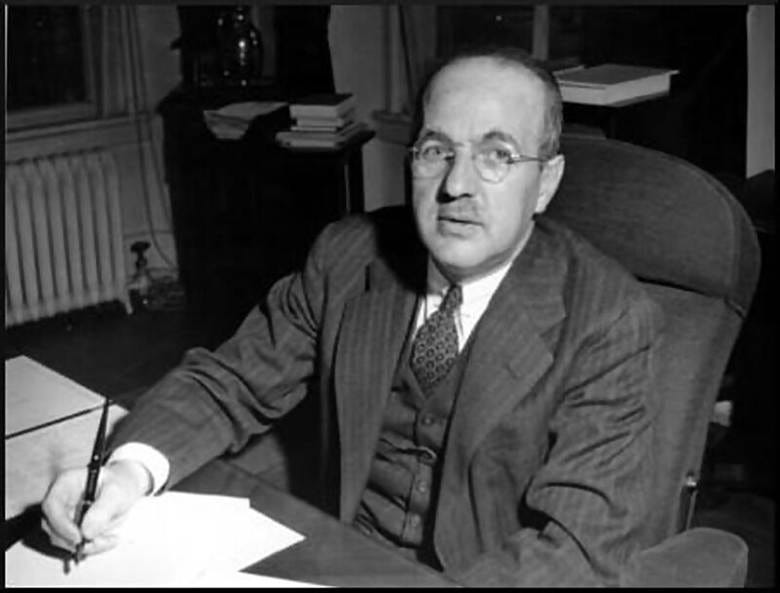
White (today slandered as a Soviet agent by CFR- affiliated historians) fought tooth and nail to ensure that Britain would not be in the driver’s seat of the new emerging economic system or the important mechanisms of the IMF that he would go onto lead. White ensured the colonial economic “preference” system Britain used to maintain free trade looting across its empire was destroyed, and the pound sterling did not play a primary role in global trade. Instead, a fixed exchange rate system was set up to guarantee that speculation could not run rampant over national growth strategies and the dollar (then backed by a powerful PHYSICAL economic platform) was a backbone for world trade. At Bretton Woods, Dexter White and Henry Morganthau reached agreements to provide vast technology transfers to help South America industrialize[9]. At the same time, large-scale programs modelled on the New Deal were presented by delegations from India, Eastern Europe, and China[10]. It is noteworthy that the Chinese delegation introduced infrastructure plans first laid out by Sun Yat-sen in his 1920 International Development of China which both Mao, and Zhou Enlai endorsed alongside the Kuomintang’s Chiang Kai-Shek! Had these plans not been sabotaged, it is amazing to consider what sort of progress might have opened up for the Chinese 70 years before anyone heard of the term “Belt and Road Initiative”.
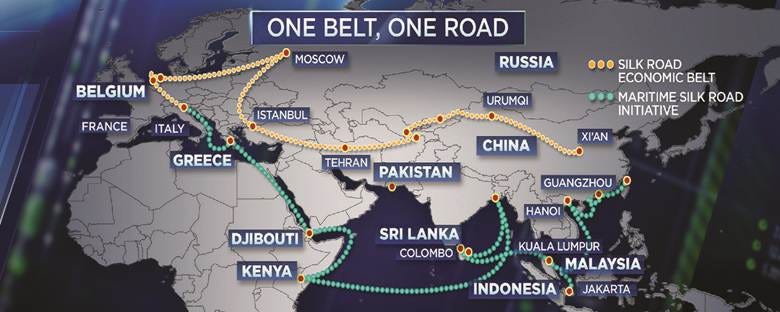
At this early stage, Russia was still happy to be a founding member of the IMF and World Bank which were designed to act as cheap lending mechanisms for long-term, low-interest, high-tech global development. Commenting on support for FDR’s post-war system of mutual interest, Stalin stated: “Can we count on the activities of this international organization being sufficiently effective? They will be effective if the Great Powers who have borne the brunt of the burden of the war against Hitler’s Germany continue to act in a spirit of unanimity and harmony. They will not be effective if this essential condition is violated”. Just as the Reconstruction Finance Corporation (RFC) was used like a national bank to fund thousands of great infrastructure, transport, energy, and water projects during the New Deal and just as Glass-Steagall broke the monopoly of private speculative finance over the productive economy, these New Dealers wished to use the World Bank and IMF to issue long term, low interest productive credit for long term mega infrastructure projects around the world. Not just in Europe’s reconstruction. Leading figures among this group of patriots included Undersecretary of State Sumner Welles, FDR’s confidant Harry Hopkins, and leader of the republican party Wendell Willkie who worked closely with his democratic rival by becoming an international ‘New Deal ambassador’ . In 1942, after being deployed by FDR on a world tour to organize an international New Deal projects in a race to end colonialism, Willkie wrote: “In Africa, in the Middle East, throughout the Arab world, as well as in China, and the whole Far East, freedom means the orderly but scheduled abolition of the colonial system. . . . When I say that in order to have peace this world must be free, I am only reporting that a great process has started which no man–certainly not Hitler–can stop. . . . After centuries of ignorant and dull compliance, hundreds of million of peoples in Eastern Europe and Asia have opened the books. Old fears no longer frighten them. . . . They are resolved, as they must be, that there is no more place for imperialism within their own society than in the society of nations.” FDR’s battle with Churchill on this matter was well documented in his son/assistant Elliot Roosevelt’s book As He Saw It (1946): “I’ve tried to make it clear … that while we’re [Britain’s] allies and in it to victory by their side, they must never get the idea that we’re in it just to help them hang on to their archaic, medieval empire ideas … I hope they realize they’re not senior partner; that we are not going to sit by and watch their system stultify the growth of every country in Asia and half the countries in Europe to boot.” This vision was expressed continually by FDR in his hundreds of speeches, as well as by his Vice-President Henry Wallace, in the creation of the Atlantic Charter, and Four Freedoms. It was embedded in the defense of national sovereignty in the UN Constitution (conspicuously non-existent in the British-directed League of Nations earlier). It was meant to be the governing spirit animating the world as mankind entered a matured age of creative reason. So What happened?As long as FDR was in office, this British-run hive was kept at bay, but as soon as he died, the infestation took over America and immediately began undermining everything good FDR and his allies had created. Upon the president’s death, Harry Dexter White was ousted from his position as director of the IMF and labelled a communist agent. Henry Wallace was ousted for similar reasons and worked with White on a 1948 presidential bid as third party presidential candidate. William Willkie (who had discussed creating a new party with FDR) died in October 1944, and FDR’s right hand man Harry Hopkins who did the most to initiate a close bond of friendship with Stalin, died in 1946. Elliot Roosevelt interviewed Stalin a few years later, and recorded that Stalin always believed that Elliot’s father was poisoned “by Churchill’s gang.”[11] By 1946, Churchill ushered in the Cold War setting former allies at each other’s’ throats for the remaining 70 years while dropping nuclear bombs on a defeated Japan. Stalin bemoaned Roosevelt’s death saying “the great dream has died”. In the wake of FDR’s death, Keynes’ model of governance which permeated the operating system of the post-war age, ensured that the sorts of INTENTION-driven large-scale projects that could finally end colonialism would not see the light of day. It took FDR’s enemies another 25 years to dismantle the fixed exchange rate system of the Bretton Woods leading to Nixon’s 1971 floating of the US dollar onto the speculative markets, converting the world ever more into a militarized casino system. Rather than used as instruments for long term growth as they were intended, the IMF and World Bank were used as tools of debt slavery and re-colonialization as outlined in John Perkins’ Confessions of an Economic Hitman[12]. Today the world has captured a second chance to revive the “great dream”. In the 21st century, this great dream has taken the form of the New Silk Road, led by Russia and China (and joined by a growing chorus of nations yearning to exit the invisible cage of colonialism. While it is hoped that the recent references to ‘The American System’ at Davos heralds an authentic restoration of healthier thinking within the American elites, the fact that John Maynard Keynes has been honored as a torch bearer of this tradition implies a dangerous Trojan Horse that may ultimately cause patriots within the USA to become instruments of their own enslavement… again. [1] The Roosevelt I Knew by Frances Perkins, Viking Press, 1946 [1.5] From Keynes: A Critical Life by David Felix: “[Keynes] advised Lytton, who was going on a holiday to Tunis and Sicily, on modalities “if you want to go where the naked boys dance.” Responding to his friend’s scatological taste, he closed with the lines from a poem: “We paid our suit to Janus/ Mistook the one mouth for the other anus.” He himself was going to join an old classmate, now a colonial officer there: “I’m leaving for Egypt… I just learned that ‘bed and boy’ is prepared.” [2] Inglorious Empire: what the British did to India, by Shashi Tharoor, London, Hurst, 2017 [3] For a fuller exposition of the origins, aims and accomplishments of the Fabian Society, see: What is the Fabian Society and to What End was it Created? By this author, Canadian Patriot Review, 2013 [4] See Chapter 4 of my book ‘Clash of the Two Americas vol 2 for the sabotage of the 1923 Rapallo Agreement [5] Keynes’s plagiarism of Malthus and McCracken by Steve Kates, History of Economic Ideas, 2010 [6] Thomas Robert Malthus by John M. Keynes, Essays in Biography, 1933 [7] The full transcript of Keynes’ 1914 speech is re-published as an appendix in Keynes on Eugenics, Race, and Population Control by Jay Taylor, Von Mises Institute, Nov. 2019 [8] The Enduring Influence of Thomas Malthus by Renee Nal, RAIR Foundation, November 14, 2019 [9] New Understanding of the Bretton Woods Agreements Opens the Door to the Four Powers Dialogue by Gerry Rose, EIR, August 21, 2020 [10] From Great Depression to Great Recession: The Elusive Quest for International Policy Cooperation Editor: Mr. Atish R. Ghosh and Miss Mahvash S Qureshi, IMF, March 30, 2017 [11] Stalin Admitted Knowledge Of English, Roosevelt’s Son Says By Rick Hampson, Associated Press, February 6, 1986 [12] Confessions of an Economic Hitman by John Perkins, Berrett =-Koehler Publishers Inc., 2004 Bio: I am the editor-in-chief of The Canadian Patriot Review, Senior Fellow of the American University in Moscow and Director of the Rising Tide Foundation. I’ve written the four volume Untold History of Canada series, four volume Clash of the Two Americas series, the Revenge of the Mystery Cult Trilogy and Science Unshackled: Restoring Causality to a World in Chaos. I am also co-host of the weekly Breaking History on Badlands Media and host of Pluralia Dialogos (which airs every second Sunday at 11am ET here).
Follow my work on Telegram at: T.me/CanadianPatriotPress
|
Monday, January 26, 2026
Has the 'American System' Been Revived at Davos... or is a Keynesian Trojan Horse Being Rolled out?










Subscribe to:
Post Comments (Atom)
The World Needs a Renaissance, Not an Enlightenment
Both the Renaissance and the Enlightenment are gravely misunderstood in the popular imagination. ͏ ͏ ͏ ͏ ͏ ͏ ...

-
Boundaries are the backbone of respect. ...
-
Yernasia Quorelios posted: " In the dream, I was queued with my friends waiting to be seated at a formal dinner that wa...
-
Everyone loves a good story. The problem is that storytelling, like any branch of art, can sometimes be a double edged sword that can make u...


No comments:
Post a Comment