By David GosselinThat little time with lyre and rhyme Is it possible that much of the world remains captive to a false Poe mythology? Whether in respect to his fiction, prose, or poetry the typical caricature of a sullen morbid eccentric continues to dominate the popular culture’s image of Edgar Allan Poe. Much of Poe’s work is treated like a Stephen King-grade thriller, spooky and entertaining, but little else. But is this disneyfied portrait justified? While often thought of as a “master of the macabre,” due to the dark themes treated in many of his stories, the popular readings have led many to treat Poe’s tales like something out a modern Hollywood film, rather than, say, a Classical Greek tragedy. In reality, both Poe’s fiction and poetry are best understood as two mutually complimentary treatments of the same poetic principle of the Sublime, which he refers to as “supernal Loveliness” and “supernal Beauty.” In “The Poetic Principle,” Poe writes:
The thread of the sublime can be traced throughout all of Poe’s works, beginning with his early poetry. But before we examine some practical examples of the poetic principle, let’s disabuse ourselves from the official Poe mythology popularized by his enemies and ill-informed critics.
Master of the Macabre?
The popular Poe mythos was demonstrably fabricated by his own personal enemy, Rufus Griswald. Griswald forged letters in Poe’s name, took over his literary estate from an impoverished aunt, and became the principle narrative controller for all things related to Poe’s legacy. Despite the deliberate slanders and toxic mythology, audiences have remained entranced by the notion of a tormented soul whose genius essentially lay in his ability to externalize the workings of his own troubled psyche. The famous French poet and Poe translator Charles Beaudelaire believed something similar, including the idea that Poe used mind-altering substances to achieve the states of dark enchantment that supposedly made his tales possible. In Edgar Allan Poe: His Life and Works, Beaudelaire writes:
As is often the case, Beaudelaire’s analysis sounds more like a textbook case of projection, given he was himself an unabashed hedonist who loved to experiment with drugs like opium and hashish. In Poe’s case, the only people presumably using opium were the deranged characters in his stories like “Ligeia” or “Berenice.” The villains and madmen in his stories almost always get what’s coming to them; and seldom escape their conscience without consequence. Time and time again, Poe’s tales harken back to the principle embodied by the Classical Greek goddess Nemesis—the goddess of justice and vengeance. Nemesis always gets retribution on behalf of the gods for acts of great hubris and violence. A higher system of law always prevails. Thus, a close reading of Poe’s work suggests he wasn’t so much a master of the macabre as a master of the Sublime. In Search of the Sublime with Schiller and Poe
It’s notable that Poe’s personal annotated copy of his beloved metaphysical prose poem Eureka contains an inscription in his own hand of the original German poem “Die Grosser der Welt” (The Greatness of the World) by Friedrich Schiller. The cosmic system detailed in Poe’s Eureka also mirrors Schiller’s own ideas of the infinite as expressed in his early metaphysical poem. So what was this Schiller poem that Poe found so affective and inscribed on the flyleaf of his own personal copy of Eureka? The author presents a new English translation of Schiller’s “Greatness of the World”:
The poem dates from Schiller’s early period. It describes a pilgrim in search of Infinity. Finally, Schiller’s pilgrim meets a fellow traveller; both find themselves surrounded by an Infinity that lies both behind and ahead of them. Rather than an infinite world unbounded by any limits, Schiller’s poem treats Infinity as the absolute limit of the world itself, beyond which none can venture. The concept functions much in the same way a negative theology treats man’s knowledge of an unknowable and infinite God as the absolute limit which circumscribes all that is knowable. To know God is to fathom the fathomless. And yet, nothing can truly be fathomed without that fathomless Infinite which bounds all Creation. Here, the imagination must “cast down its anchor dejectedly” and wrestle with a Truth that escapes all comparison in words or images. As Poe argues in Eureka, such knowledge is best approached with a poetical intuition, rather than mathematical or linear logic. But despite the limitation of words and images, words and images are essentially all man has to work with. Hence, the purpose of poetry is to use words and images in ways that allow us to transcend their inherent limitations. In “The Poetic Principle,” Poe describes the deeper spiritual implications of this poetical principle, first as it relates to words and images, and then to poetry and music proper:
Quoting Shelley, Poe refers to as innate spiritual hunger as “the desire of the moth for the star.” Man is endowed with the unique capacity to fathom the fathomless; through a sublime disposition, he becomes capable of developing the ability to personally acquaint himself with this supernal spring of Loveliness. Here, music and poetry become the ideal mediums through which this immortal thirst can be awakened in our fellow mortals. And that leads us to Poe’s own supernal aesthetic. The Search for the Supernal
From the time of his earliest poems, we see the thread of the sublime and a kindred Schillerian spirit running throughout Poe’s work. Take a simple strophic example like “To One in Paradise” (1831):
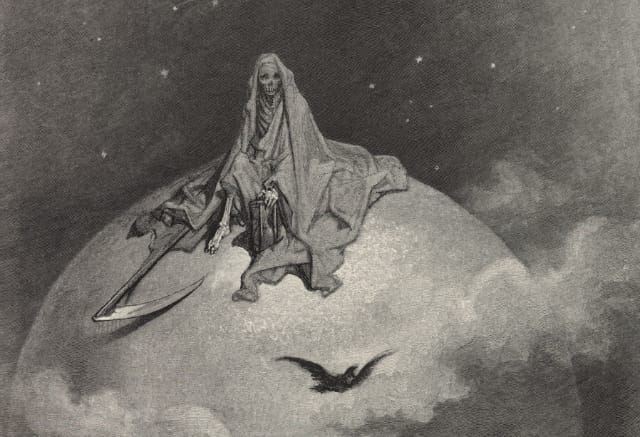
Poe’s longing is personified by someone who once tread the earth, but who has since departed from earth and dwells in paradise. Despite her parting from the sublunary realm and its fruits and flowers, the paradisal figure continues to animate all his dreams and trances back on earth. The poem perfectly captures the tension that Poe explores throughout his poetical works. The Philosophy of CompositionIn his “Philosophy of Composition,” Poe walks us through the thinking process involved in creating a similar, albeit more elaborate and memorable work of the sublime, “The Raven.” Like many of his poems, “The Raven” demonstrates the same idea of reaching for a “something in the distance”—in this case a beloved—only this time he uses a more refined and sophisticated form of narrative and versification. Poe specifically identifies his idea of sublime beauty as an effect that must be consciously created, and which in turn has the power to awaken a new sensibility in man through the pleasure it arouses:
Interestingly, Poe’s notion of an immortal instinct echoes Schiller’s own idea of the Sublime, which he described as a delight “widely preferred to every pleasure by fine souls”:
Poe is concerned with the kind of Beauty that is neither purely sensual nor intellectual, but the sublime kind whose effect he describes as a “pure elevation of the soul.” Poe proceeds to outline the various kinds of subjects, tones and poetical forms that most fittingly assist in the creation of such Beauty. In respect to tone, Poe writes:
Another chief concern for Poe was the musicality of poetry, given its unrivalled ability to generate the various states of emotion that are conducive to awakening the “immortal instinct.” Whether the desired state of emotion is sadness, joy, desire, or horror, a different kind of musicality is appropriate, just as the Greeks used anapestic meters for elegies, dactyls for epics, iambs for comedy and countless metrical variations depending on the kind of song intended. Poe writes:
Hence, “The Raven’s” weightier trochaic rhythms and the stark concluding refrains of “Nevermore,” which echo like a melody in the minds of audiences long after they’ve read or heard the poem. Poe proceeds to describe his process for selecting the most fitting topic for poetical development:
Thus, rather than being the product of some morbid eccentricity or symptom of some incurable melancholy spurred by Saturnian influences, Poe’s fascination with images of death, the departed, the haunted and the spiritual are emblematic of his efforts to perfect an aesthetic of the sublime—an effort cut short by his own mysterious death. On the Threshold the SublimeBoth Poe and Schiller describe an immortal or “independent principle,” which exists in man whether he chooses to act on it or not, whether he strives towards it or runs from it in fear—whether he embraces destiny or tries to cheat Fate. The purpose of sublime art is to awaken and strengthen the immortal instinct which makes men emotionally capable and willing to envision and pursue lofty ideals in the first place. For as we know, every idea—beautiful or perverse—begins in the imagination. Without adequate aesthetic judgement, ugly ideas may appear beautiful, sublime haunting or dangerous. When the desire for Supernal Loveliness becomes transparent, it becomes abundantly clear that our higher innate desires cannot be quenched by anything less. On the other hand, those who lack the needed sensitivity are the ones usually visited by the perverse “imps” detailed in Poe’s tales. Thus for Poe, the Perverse is treated as the natural inversion of the Sublime. In the former, the universe asserts itself in opposition to the will of the Perverse; in the latter, the Sublime asserts itself in favor of a higher system of law. And nothing is more delightful. “Sweets and Sours”
In another early poem, Israfel (1831), we find the most transparent poetical example of Poe’s underlying philosophy, which he would hone and refine throughout his life. The poem draws on the tension between the imperfections of the earthly realm—“a world of sweets and sours”—and the realm of angels. It begins with an inscription:
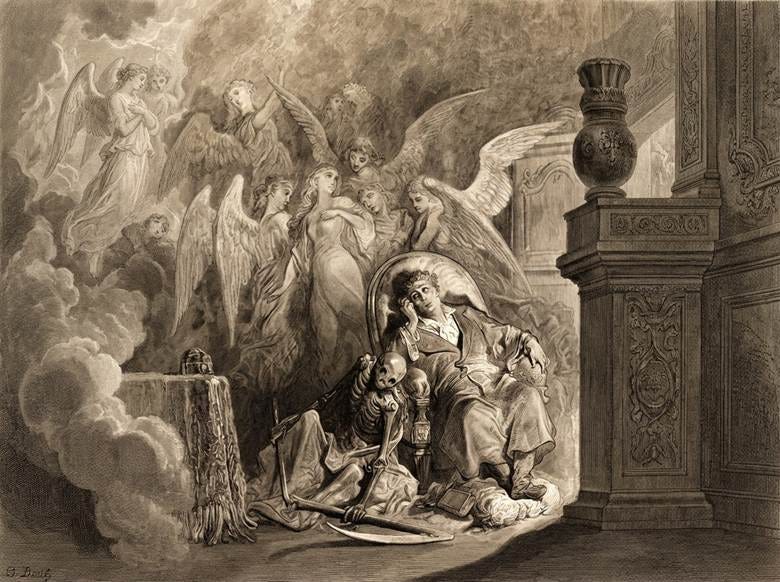
Poe describes a spirit in Heaven whose songs are perfect in comparison to his earthly ditties. The poem is ostensibly about music—and those who sing with passion vs. those who lack passion in their song. However, a qualitative change occurs in the poem when the narrator begins to explain the reason for the discrepancy between his songs and those of Israfel:
The narrator offers a defense of his own imperfect songs, arguing that any lack of fervor or passion in his mortal melodies isn’t due to any lack of desire on his part, but the fact that he is still bound by his earthly coil, and must therefore suffer the “sweets and sours”—the harmonies and disharmonies—that characterize the created world. The tension between one’s hopes and desires, abilities and limitations, creates precisely the kind of poetical tension and longing that awakens in us an awareness of both our “thirst unquenchable” and the inherent limits of our powers. However, rather than being demoralizing, the unattainability of Israfel’s heavenly musical perfection becomes itself a limitless font of inspiration on earth for all those who long to create heavenly music. We feel both a sorrow and the sweetness in our inadequacy, whose final resolution “we attain to but brief and indeterminate glimpses” in dreams and songs. The poem, like most of Poe’s poetry, is an invitation to join him in drinking from the true fount of all immortal inspiration, and to acquaint ourselves with those poetical crystal springs which flow forevermore. In this way, we may nurture ourselves and our fellow mortals with the same “desire of the moth for the star” which Poe fed on until his dying day. David Gosselin is a poet, translator, and linguist based in Montreal. He is the founder and Editor in Chief of the New Lyre journal and he publishes on Age of Muses. His first collection of poems is entitled Modern Dreams. David is also the Director of the newest Rising Tide Foundation documentary ‘Edgar Poe’s Final Mystery: A Tale of Two Murders’ which can be viewed here: 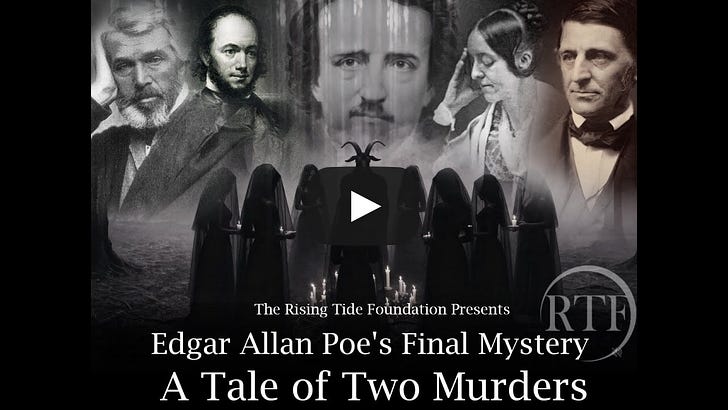 The Rising Tide Foundation (RTF), a non-profit based out of Montreal, Canada, dedicated to the rigorous re-examination of Universal History and the principles governing the cyclical appearance of Renaissances and Dark Ages in human civilization. Consider supporting our work by subscribing to our substack page and Telegram channel at t.me/RisingTideFoundation.
You're currently a free subscriber to Rising Tide Foundation. For the full experience, upgrade your subscription.
|
Thursday, January 22, 2026
Edgar Allan Poe and the Search for the Supernal




Subscribe to:
Post Comments (Atom)
by making exceptions, you're giving permission
permission for how someone can treat you... ...

-
Boundaries are the backbone of respect. ...
-
Yernasia Quorelios posted: " In the dream, I was queued with my friends waiting to be seated at a formal dinner that wa...
-
Everyone loves a good story. The problem is that storytelling, like any branch of art, can sometimes be a double edged sword that can make u...


No comments:
Post a Comment